The mystical traditions, read in their own words
An open reference for the contemplative, mystical and esoteric traditions of the world. Every text shows its translator, its source and what has been checked. Edited by Vincent Couey.
Trinity, beyond-being and beyond-divine and beyond-good, overseer of the Christian wisdom of God…
Seven translations a scholar can already trust
Each is a published human translation in the public domain, reproduced with its source. They sit in order of translation year. Pick a spine.
Six reasons people come, each with a route
Pick what you want and get an ordered path through real pages.
What Hekhal is
Hekhal is an open reference for the primary texts of Jewish, Christian and Islamic mysticism and the traditions beside them. It publishes 305 text pages with the original beside an English rendering, a lexicon of 201 terms in their own scripts, concept maps that mark each link between traditions as documented transmission or structural parallel, and free PDF and ePub editions. Every text shows its translator, its source and its review status; many editions are AI-assisted drafts flagged provisional pending scholarly review. Everything is openly licensed (CC BY-SA 4.0), ten editions carry citable DOIs, and the project is edited by Vincent Couey.
About How claims are checked The texts The lexicon Open data
Targum תרגום ترجمة ἑρμηνεία
A purpose-built translation engine for the contemplative, mystical, and esoteric literatures. Frontier-model generation scaffolded over a controlled lexicon, school-and-period scoping, hermeneutic-frame controllers, multi-pass output, and a public audit trail.
What it does that a chatbot cannot.
Most of the esoteric corpus is functionally untranslated, locked behind paywalled academic editions or unrendered into English at all. Generic LLMs flatten the technical vocabulary, mistake the register, and silently drop the hermeneutic structure the tradition uses on itself.
Targum scopes each translation to its corpus and period, retrieves
the controlled vocabulary per passage, and runs the output
through a frame controller, zahir-batin for Akbarian
sources, kataphatic-apophatic for Christian apophatic,
pardes for Kabbalah, merkavah-ascent for
the new Heikhalot corpus. Every word choice carries a queryable
record. No auto-publish.
al-Insān al-Kāmil, the complete 63-chapter edition. The first known complete Arabic and English parallel rendering of al-Jīlī's masterwork, every chapter line by line, two-witness collated, every Qurʾānic locus verified against the muṣḥaf. Read it in the navigable reading surface, where the translation, its apparatus, and the mapped scholarly debate compose on one page.
Open the reader → Browse the catalog →Comparative source sheets
The same passage set beside its witnesses: one verse, its translations and tellings laid side by side, so the places the tradition diverges become visible. Free, public-domain, apparatus-bearing, from a child’s first Shema to a seminary seminar. For study, not for ruling.
The Hekhal Shop
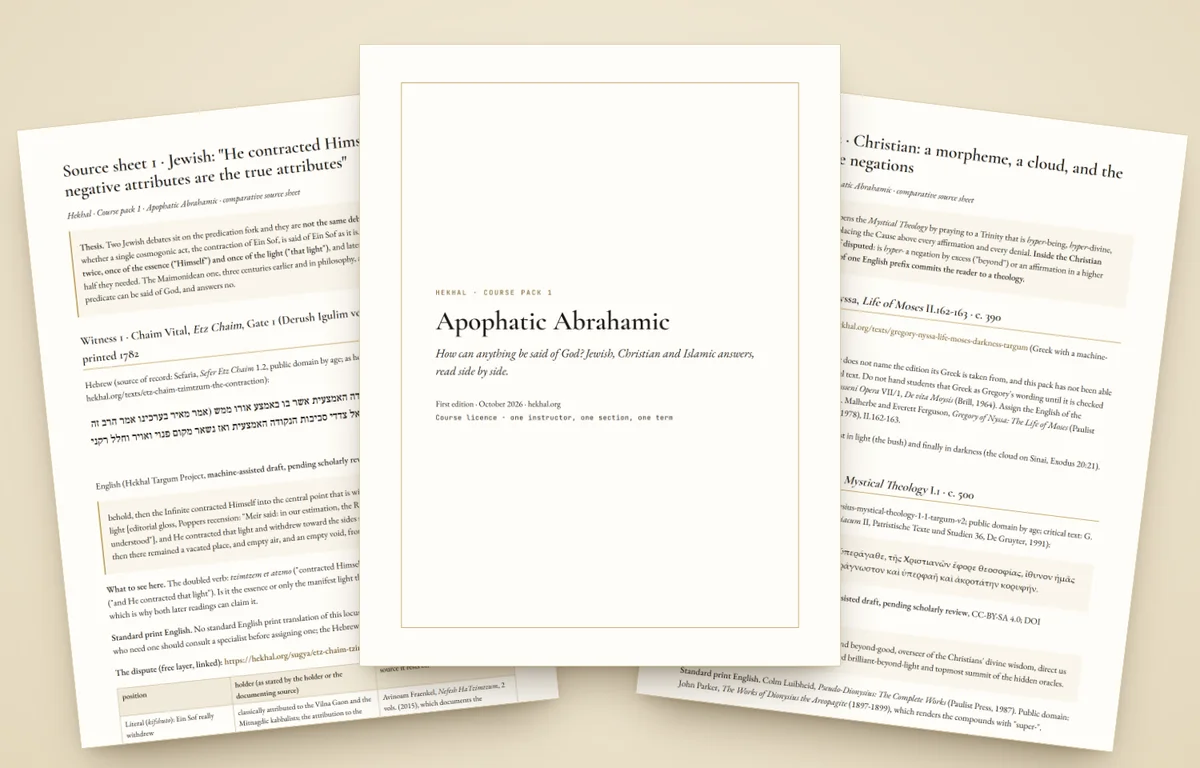
Apophatic Abrahamic
How can anything be said of God? A ready-to-teach module across the three traditions: syllabus, four source sheets in Hebrew, Greek and Arabic beside English, assignments with rubrics, instructor notes.
Read the free sample week →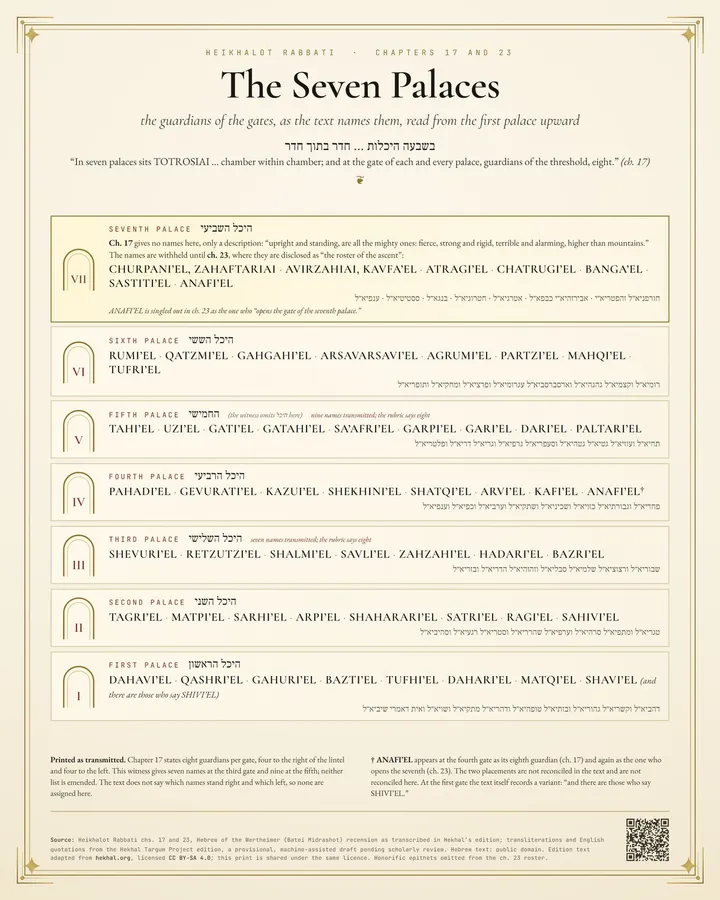
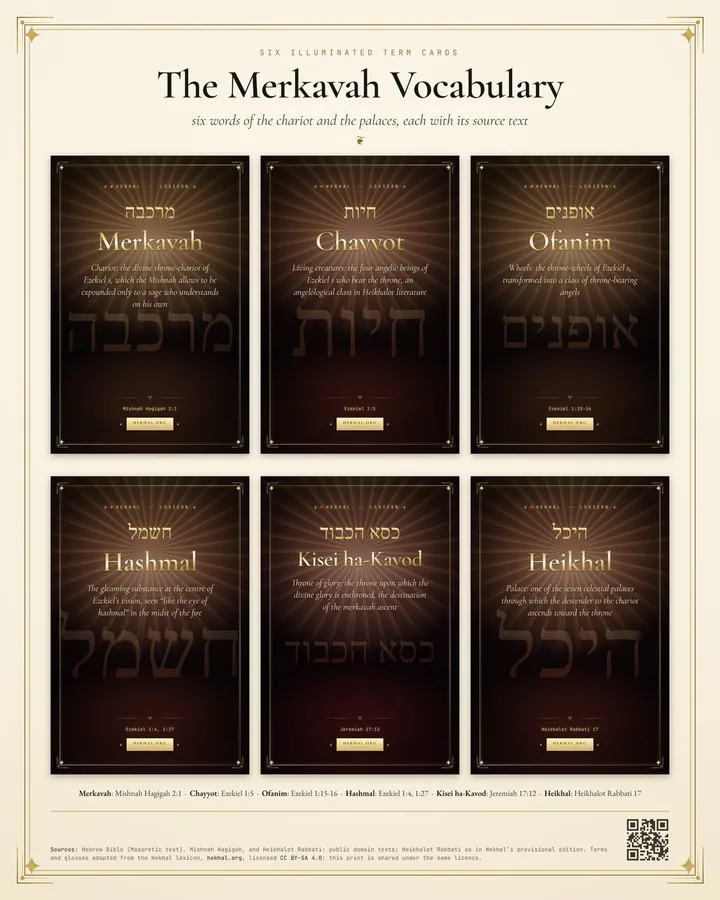
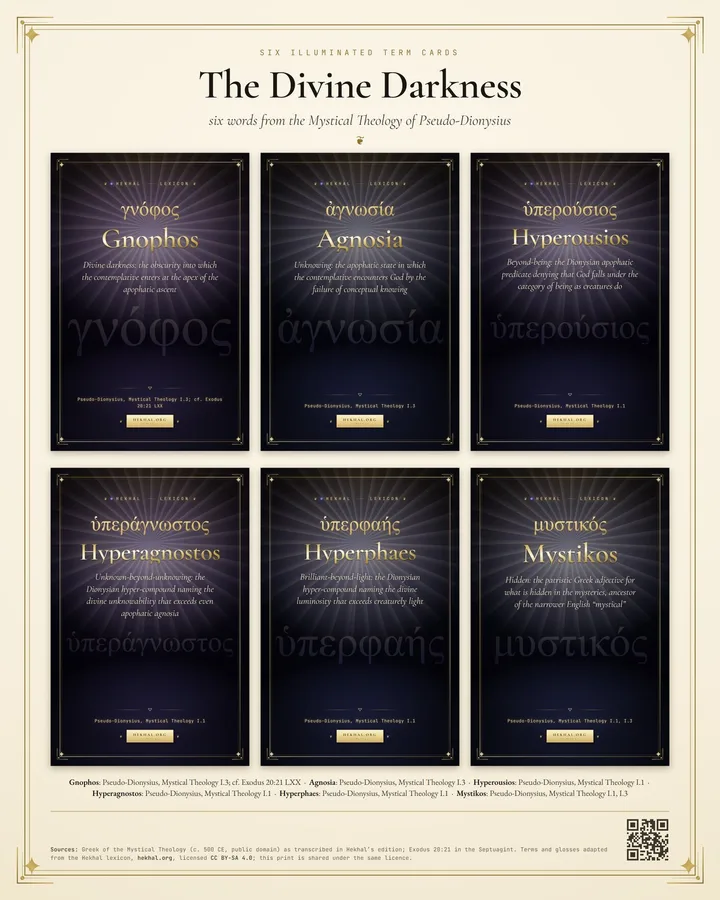 Printable editions Diagrams, a three-tradition timeline and illuminated term cards, every source named on the print. From $7.
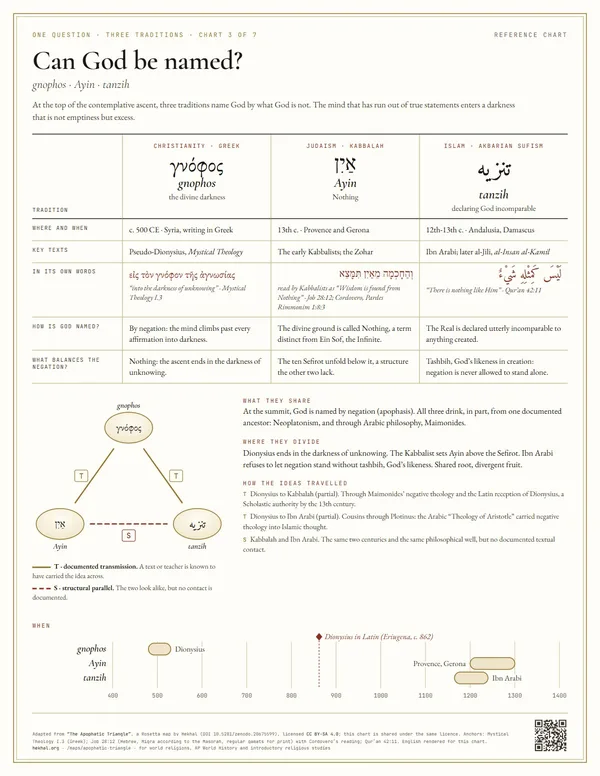
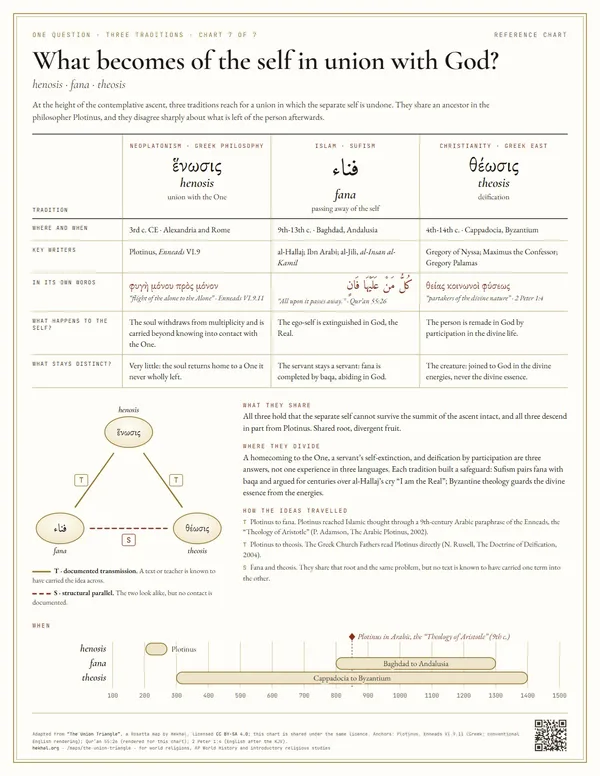
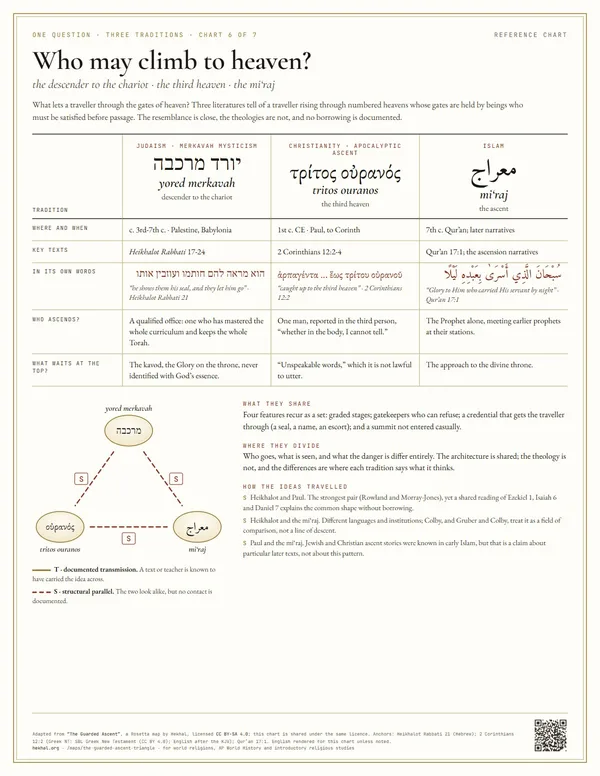 Classroom charts Seven comparison charts with worksheets and answer keys. One is free; all seven $14. Live, with the editor Reading the mystics side by side A four-session reading course, capped at 25. Join the waitlist to hear first. Programs and presses For institutions Course licences, commissioned editions, and verification of machine translations.
Three tiers, structurally kept apart
What a source is decides where it lives, how it looks and what may cite it. The wording below is the site's own.
Canonical
Primary texts, traditional commentary, Hekhal's own codex entries on a corpus. Provenance always. Translator named. Original language hosted alongside.
Reception
Modern scholarship and philosophical bridge work: Scholem, Corbin, Idel, Faivre, Hanegraaff. Distinguished visually so synthesis is not confused with source.
Containment
Folk reception, modern occult orders, contemporary fringe, AI-generated grimoire material. Indexed and available, never authoritative.
The library
Jewish Mysticism
בִּשְׁלשִׁים וּשְׁתַּיִם נְתִיבוֹת פְּלִיאוֹת חָכְמָה
With thirty-two wondrous paths of wisdom...
Sefer Yetzirah § 1
Islamic Mysticism
كُنْتُ كَنْزًا مَخْفِيًّا فَأَحْبَبْتُ أَنْ أُعْرَفَ
I was a hidden treasure, and I loved to be known...
hadith of the hidden treasure
Christian Mysticism
εἰς τὸν γνόφον τῆς ἀγνωσίας
into the divine darkness of unknowing...
Pseudo-Dionysius · MT 1.3
Hellenistic and Hermetic
ὁ νοῦς ὁ ἐμός, τίνα βούλει νοῆσαι;
My mind, what do you wish to know?
Corpus Hermeticum I.1 · Poimandres
305 texts · 201 lexicon entries · 13 corpora · all corpora →
Have an interest? Search Hekhal for it.
Every openly-licensed, citable thing Hekhal has made — editions, concept maps, mapped debates, the lexicon, the methodology — in one place, all with provenance.
Search the storeroom…Four paths, drawn as one transit map
Where two paths share a text or a term, the lines meet at an interchange. Pick a path to see its stops in order.
Ten editions and maps, each with a DOI
Deposited on Zenodo under the editor's ORCID, openly licensed CC-BY-SA-4.0. Five are shown here, newest first.
A named editor, and a door for reviewers
Vincent Couey
Prepares the bilingual editions and cross-tradition maps, and signs the editorial law.
ORCID 0009-0005-6869-308X
A scholar's name on an edition
Read a machine-assisted draft against its source. On sign-off it graduates and carries your name and the date.
Become a reviewer →Found an error?
Every edition has a report-an-error route, and the editor answers.
vinnycouey@gmail.com