Figures
The masters whose work constitutes the corpora Hekhal documents. Not hagiography, not dismissal: vital statistics, intellectual development, key contributions, the controversies, and the transmission lines into and out of each figure's work.

Vilna Gaon
The Lithuanian rabbinic-mystical genius of the eighteenth century, simultaneously the dominant Talmudic-halakhic mind of his generation, a deeply learned practitioner of Lurianic Kabbalah, and the principal opponent of nascent Hasidism. Architect of the Mitnagdic intellectual stance and source of the Volozhin yeshiva tradition that has shaped Lithuanian-tradition Orthodoxy for two centuries. The unusual integration of analytical Talmudism, Lurianic Kabbalah, and natural-philosophical breadth defines his distinctive position in modern Jewish intellectual history.

Gershom Scholem
The German-Israeli historian-philologist who founded the modern academic study of Jewish mysticism. Author of Major Trends in Jewish Mysticism, Sabbatai Sevi, and Origins of the Kabbalah; demonstrated Mosheh de León's authorship of the Zohar; reframed the Sabbatean movement as central rather than aberrant to Jewish religious history. Hosted at Hekhal as the principal modern interpreter whose work is itself a distinct scholarly register, not a continuation of the canonical Kabbalistic tradition.
Mosheh de León
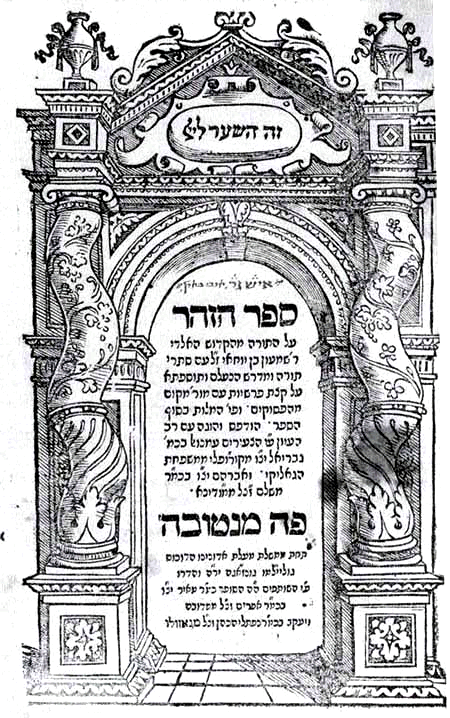
The Castilian Kabbalist whose composition and circulation of the Zohar in the last decades of the thirteenth century produced the central work of Jewish mystical literature. The pseudonymous attribution to the second-century Tannaitic master Shimon bar Yochai shaped the Zohar's reception for seven centuries before modern philological scholarship established de León's authorship.

Isaac Luria
The Safed kabbalist known as the Ari, the Lion, whose two-year teaching career in Galilee produced the most consequential reformulation of Kabbalistic doctrine after the Zohar. The Lurianic synthesis -- tzimtzum, the breaking of the vessels, the partzufim, tikkun, and gilgul -- became the dominant framework within which traditional Kabbalah, Sabbateanism, and Hasidism subsequently operated.

Henry Corbin
The French philosopher-Iranist who became the principal modern Western interpreter of Islamic mystical philosophy, especially the Akbarian, Illuminationist, and Shi'i-esoteric traditions. Author of Creative Imagination in the Sufism of Ibn 'Arabi, En Islam iranien, Spiritual Body and Celestial Earth, and Avicenna and the Visionary Recital; principal articulator of the mundus imaginalis ('alam al-mithal) for Western thought. Hosted at Hekhal as a twentieth-century scholar whose synthesis is itself a distinct register, not a continuation of the canonical mystical traditions he interpreted.

Ibn Arabi
The Andalusian-Damascene Sufi metaphysician known in the tradition as al-Shaykh al-Akbar, the greatest master. Founder of the Akbarian school, principal architect of the doctrine of wahdat al-wujud, and the most consequential single figure in the history of Islamic mystical thought.

Al-Ghazali
The Persian Sunni theologian, philosopher, and Sufi whose Ihya' Ulum al-Din synthesized orthodox Sunni theology with Sufi contemplative practice and shaped Sunni Islam's relationship to mysticism for the next nine centuries. Known in the tradition as Hujjat al-Islam, the Proof of Islam.

Suhrawardi
The Persian philosopher who founded the Illuminationist (Ishraqi) school, the second great current of post-Avicennan Islamic philosophical thought. Executed in Aleppo at age 36 on charges of heretical opinions, Suhrawardi produced in a brief working life a metaphysics of light that recovered the Persian sage-tradition and reorganized Avicennan philosophy around an angelological hierarchy of luminous beings.

Jacob Boehme
The Görlitz Lutheran shoemaker-mystic of the early seventeenth century and the most influential single figure in the history of Protestant theosophy. Author of Aurora, Mysterium Magnum, and De Signatura Rerum; architect of the doctrines of the Ungrund, the seven Quellgeister, the divine-Sophianic feminine, and the dialectic of wrath and love within the Godhead. Transmitted through William Law, the Cambridge Platonists, Hegel, Schelling, and Berdyaev into the central currents of modern Western philosophical theology.

Meister Eckhart
The Dominican preacher and theologian whose German vernacular sermons brought Pseudo-Dionysian apophatic theology into late-medieval pastoral practice. Condemned in 1329 by papal bull for the strength of his union claims; recovered as one of the most consequential figures in Western Christian mysticism by twentieth-century scholarship.

Pseudo-Dionysius the Areopagite
The anonymous late-fifth or early-sixth-century Christian author who wrote in the persona of the Athenian convert mentioned in Acts 17:34. The four surviving treatises and ten letters of the Dionysian corpus Christianized late-antique Neoplatonist metaphysics and shaped Western Christian apophatic theology more than any other single source.
Teresa of Ávila
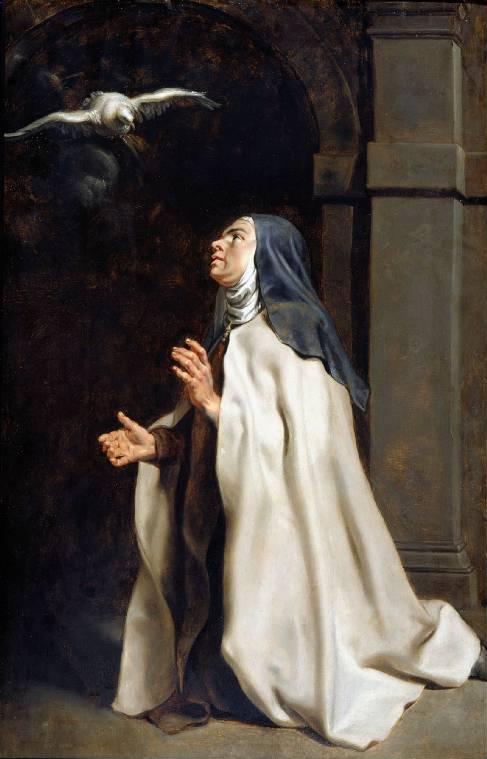
The Discalced Carmelite reformer, mystical writer, and Doctor of the Church whose Interior Castle (1577) and broader theological corpus produced the most systematic articulation of contemplative-mystical theology in the Christian tradition. Co-founder with John of the Cross of the Carmelite reform; first woman declared a Doctor of the Church (1970).

The Cloud-Author
The anonymous late-fourteenth-century English contemplative author of The Cloud of Unknowing and the related corpus of six surviving works, including a Middle English translation of Pseudo-Dionysius's Mystical Theology. Probably an East Midlands Carthusian or Augustinian writing as a spiritual director for an aspirant contemplative, the Cloud-Author transmitted the Dionysian apophatic tradition into vernacular English at a moment of substantial English mystical-textual flourishing.
