Sefer Yetzirah §§ 1-2; the thirty-two paths and the ten Sefirot (v2 ll scaffolding)
ספר יצירה · א · א-ב
Sefer Yetzirah · Anonymous; pseudepigraphically ascribed to the patriarch Abraham. Composed c. 2nd-9th century CE; the dating is contested, with Hayman 2004 favoring an earlier (late-antique) provenance.
Sefer Yetzirah §§ 1-2; the thirty-two paths and the ten Sefirot (v2, full scaffolding)
Sefer Yetzirah
Hebrew· c. 2nd-9th c. CE· canonical
Anonymous; pseudepigraphically ascribed to the patriarch Abraham. Composed c. 2nd-9th century CE; the dating is contested, with Hayman 2004 favoring an earlier (late-antique) provenance.
By thirty-two wondrous paths of wisdom did Yah, YHVH of Hosts, God of Israel, the Living God and King of the universe, El Shaddai, merciful and gracious, high and exalted, dwelling-forever, and holy is His Name, engrave —
Ten sefirot of nothingness (beli mah), and twenty-two foundational letters: three mothers, seven doubles, and twelve simples.
The number on each clause is how many readings touch it (the heat-map). Click it to focus the Sugya panel; hover a reading to light up its clause.
⁂ In depth a fuller, illustrated account
About Sefer Yetzirah §§ 1-2; the thirty-two paths and the ten Sefirot (v2, full scaffolding)
Sefer Yetzirah (ספר יצירה, the "Book of Formation") is among the oldest surviving works of Jewish esoteric cosmology, variously dated from the second to the ninth century CE. Terse and oracular; the whole text runs to barely 1,600 words; it sets out a theory of creation built from two sets of elements: the ten sefirot belimah, the ineffable enumerations, and the twenty-two letters of the Hebrew alphabet. Together these form the "thirty-two wondrous paths of wisdom" (netivot) through which, the text says, the divine engraved and created the world.
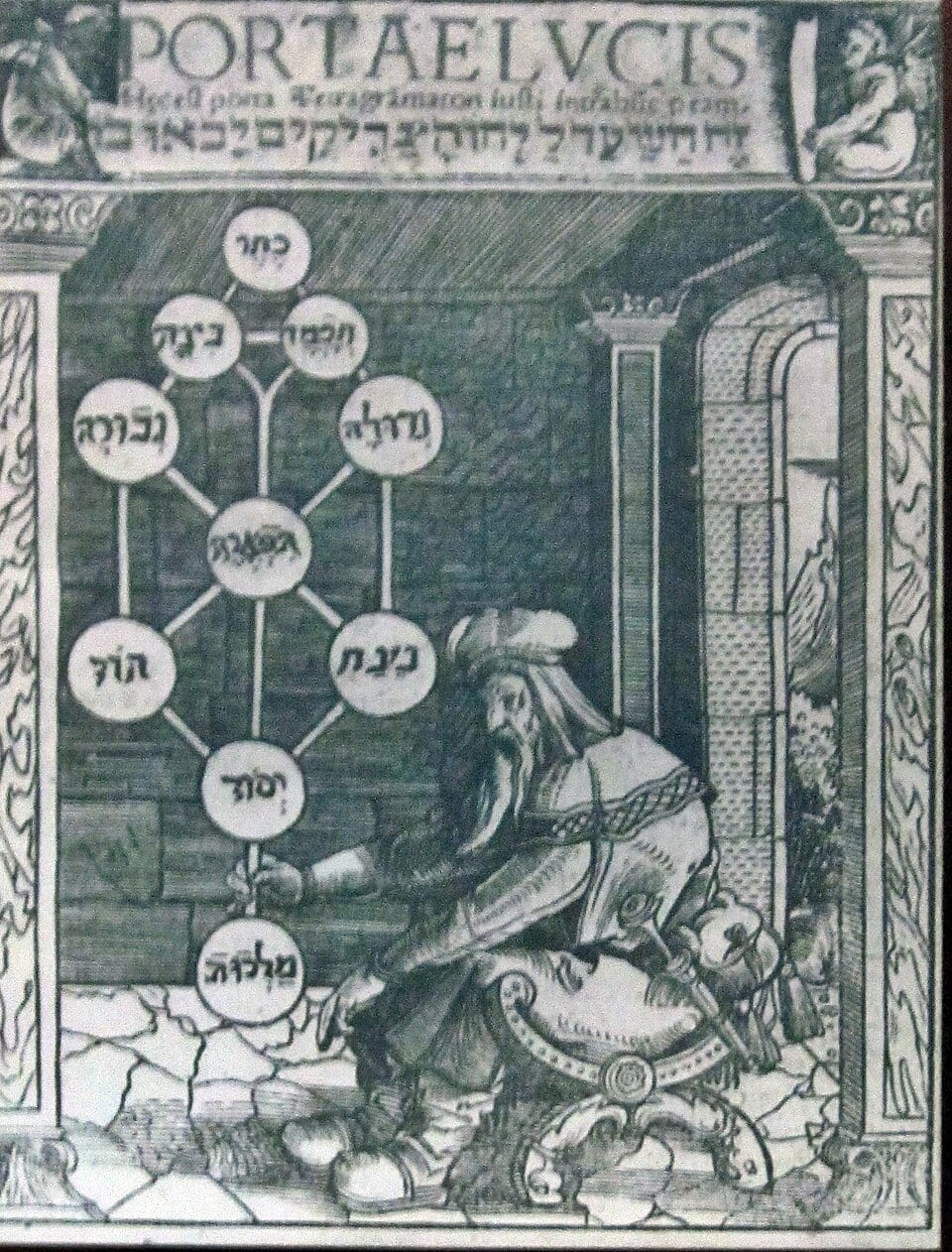
A kabbalist holds the Tree of the Sefirot on the title page of Portae Lucis (the Latin Gates of Light), Augsburg 1516; the first time the diagram reached print in the Christian West. · Leonhard Beck, 1516 (PD)
The opening verses translated here (1.1 and 1.2) lay out the book's governing scheme. Creation proceeds bi-sheloshah sefarim, "with three books," in a deliberate play on the shared root s-p-r: with sefer (text), sefar (number), and sippur (telling, or speech). The sefirot appear here before they take on the fully theosophical role they acquire in the later Kabbalah; they hover between bare countings of cosmic structure and an apophatic, belimah-bounded ontology. The Targum apparatus on this page preserves that tension rather than resolving it, which is why the same line can be rendered toward "enumerations" or toward "spheres" depending on the frame.
Pseudepigraphically ascribed to the patriarch Abraham, Sefer Yetzirah became foundational for the medieval mystics and drew a long line of commentary; from Saadia Gaon and Dunash ibn Tamim in the tenth century to the Gerona circle and the early kabbalists. Its pairing of letter and number, sound and structure, is the conceptual seed of the later doctrine of the Tree of the Sefirot, pictured at right in its first printed European depiction.
Hekhal · Reader's editionספר יצירהSefer Yetzirah §§ 1-2; the thirty-two paths and the ten…9 pages · PDF · ePub
Free · Reader's edition
Take this text with you.
This edition as a book: the original and the English facing each other, the full apparatus and notes, a citation line and the licence, typeset to print or to read on an e-reader. The text stays free online; the files are yours to keep and share.
Anonymous; pseudepigraphically ascribed to the patriarch Abraham. Composed c. 2nd-9th century CE; the dating is contested, with Hayman 2004 favoring an earlier (late-antique) provenance.
The underlying text is in the public domain by age. The original-language text is reproduced verbatim from a digital transcription of a public-domain text; the licence of that transcription is not stated as open (a verbatim transcription of a public-domain text carries no new copyright under US law), and this English rendering and its apparatus are a provisional scholarly draft, released openly for correction and not yet reviewed by a credentialed editor.
Cite this page
Stable URLs are part of the editorial commitment. This address will not change.
Anonymous; pseudepigraphically ascribed to the patriarch Abraham. Composed c. 2nd-9th century CE; the dating is contested, with Hayman 2004 favoring an earlier (late-antique) provenance.. "Sefer Yetzirah §§ 1-2; the thirty-two paths and the ten Sefirot (v2, full scaffolding)." Hekhal: An Open Reference for Esoteric Tradition. Last modified August 13, 2026. https://hekhal.org/texts/sefer-yetzirah-1-1-2-targum-v2.
Anonymous; pseudepigraphically ascribed to the patriarch Abraham. Composed c. 2nd-9th century CE; the dating is contested, with Hayman 2004 favoring an earlier (late-antique) provenance.. 2026. "Sefer Yetzirah §§ 1-2; the thirty-two paths and the ten Sefirot (v2, full scaffolding)." Hekhal: An Open Reference for Esoteric Tradition. https://hekhal.org/texts/sefer-yetzirah-1-1-2-targum-v2.
Anonymous; pseudepigraphically ascribed to the patriarch Abraham. Composed c. 2nd-9th century CE; the dating is contested, with Hayman 2004 favoring an earlier (late-antique) provenance.. "Sefer Yetzirah §§ 1-2; the thirty-two paths and the ten Sefirot (v2, full scaffolding)." Hekhal: An Open Reference for Esoteric Tradition, Aug 13, 2026, hekhal.org/texts/sefer-yetzirah-1-1-2-targum-v2.
Anonymous; pseudepigraphically ascribed to the patriarch Abraham. Composed c. 2nd-9th century CE; the dating is contested, with Hayman 2004 favoring an earlier (late-antique) provenance.. (2026). Sefer Yetzirah §§ 1-2; the thirty-two paths and the ten Sefirot (v2, full scaffolding). Hekhal: An Open Reference for Esoteric Tradition. https://hekhal.org/texts/sefer-yetzirah-1-1-2-targum-v2
@misc{hekhal-texts-sefer-yetzirah-1-1-2-targum-v2-2026,
author = {{Anonymous; pseudepigraphically ascribed to the patriarch Abraham. Composed c. 2nd-9th century CE; the dating is contested, with Hayman 2004 favoring an earlier (late-antique) provenance.}},
title = {{Sefer Yetzirah §§ 1-2; the thirty-two paths and the ten Sefirot (v2, full scaffolding)}},
year = {2026},
publisher = {{Hekhal: An Open Reference for Esoteric Tradition}},
url = {https://hekhal.org/texts/sefer-yetzirah-1-1-2-targum-v2},
urldate = {[date accessed]}
}
Author
Anonymous; pseudepigraphically ascribed to the patriarch Abraham. Composed c. 2nd-9th century CE; the dating is contested, with Hayman 2004 favoring an earlier (late-antique) provenance.
Title
Sefer Yetzirah §§ 1-2; the thirty-two paths and the ten Sefirot (v2, full scaffolding)