Sefer Yetzirah (complete)
ספר יצירה
Sefer Yetzirah · The Book of Formation · Anonymous; pseudepigraphically ascribed to the patriarch Abraham
- TranslatorHekhal Targum Project (machine-assisted draft; pending scholarly review)
- LicenceHebrew text public domain (Warsaw 1884 print, via Sefaria); Hekhal English rendering + apparatus CC-BY-SA-4.0
- Statuscanonical
- Source of recordsefaria.orgopen the scan or edition
- Last revised2026-11-17
About Sefer Yetzirah (complete)
Sefer Yetzirah (ספר יצירה, "the Book of Formation") is a short Hebrew work on how the world was made out of number and letter. It counts thirty-two paths of wisdom: the ten sefirot "without what", and the twenty-two letters of the Hebrew alphabet, divided into three mothers, seven doubles and twelve simples. Each group is traced through three realms: the world, the year and the human body.
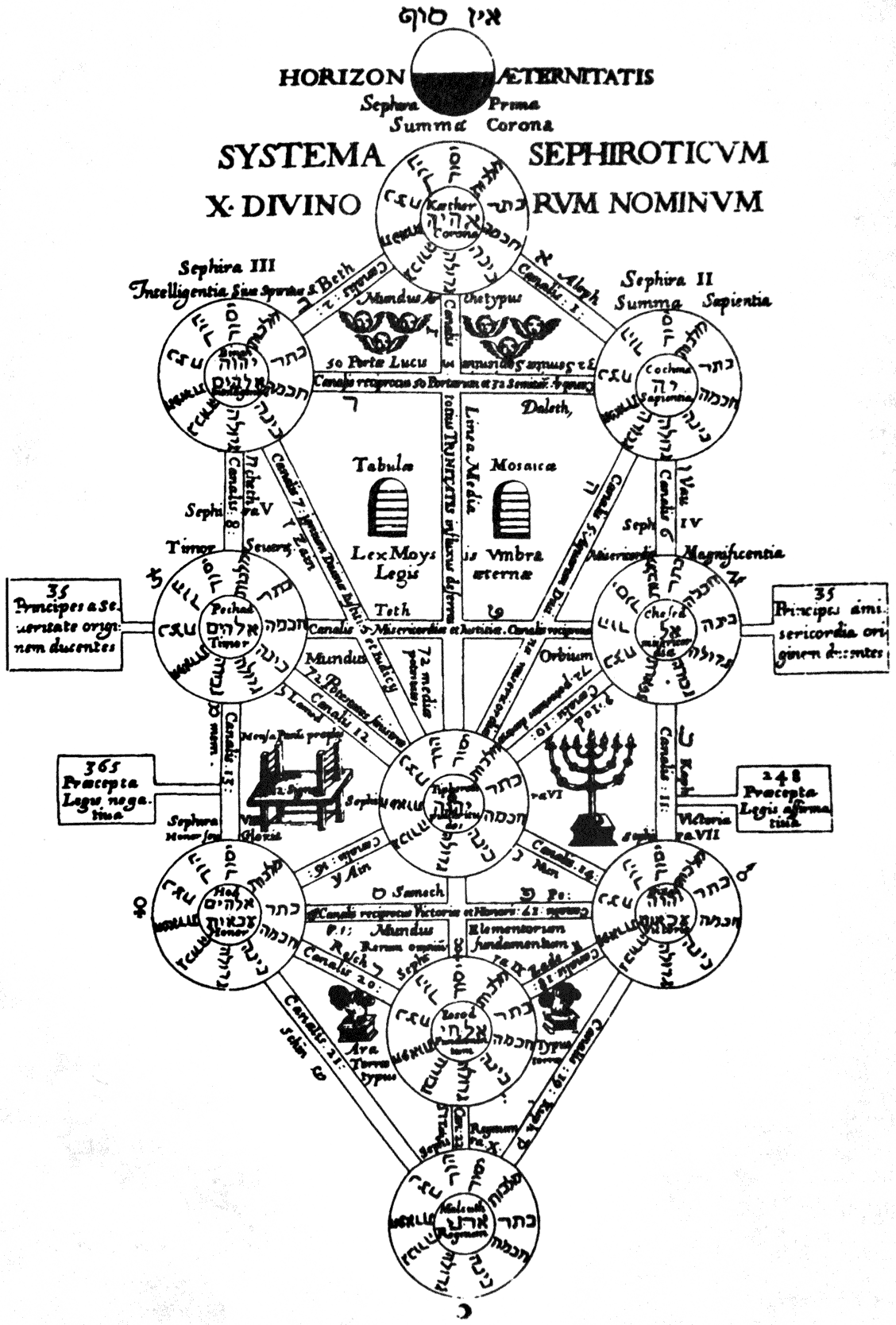

Hekhal publishes all six chapters in Hebrew and English with a full apparatus, from the common printed text (Warsaw 1884). The book has been put into English many times, from Kalisch (1877) and Westcott (1887) to Kaplan (1990) and Hayman's scholarly edition (2004); this edition adds an open-licence text with its reading decisions recorded.
Sefer Yetzirah: the Book of Formation, complete
Sefer Yetzirah is barely seventeen hundred words long in the form printed here, and it drew commentaries from philosophers and kabbalists alike for most of a thousand years. Its first chapter sets out the ten sefirot: ten and not nine, ten and not eleven, their end fixed in their beginning like a flame bound to a coal. The second chapter turns to the twenty-two letters, engraved in voice, hewn in breath and fixed in the mouth, and combined with one another through 231 gates. Chapters three to five take the letters group by group: the three mothers alef, mem and shin (air, water and fire), the seven doubles (the planets, the days of the week and the seven openings of the head), and the twelve simples (the constellations, the months and the limbs and organs). The sixth chapter gathers the whole into a single order and ends with Abraham, who looked, saw, searched and understood, and with whom the Lord of all made a covenant.
The text survives in several forms. Scholars distinguish a short, a long and a Saadian recension in the manuscripts, and the Vilna Gaon’s revision (the Gra version) is counted as a fourth. This edition translates the common printed text as it stands in the Warsaw 1884 edition, editors’ brackets included, and does not attempt the other forms. Sefaria also carries the Gra version and the text of Eisenstein’s Otzar Midrashim in the public domain. Readers who need the manuscript recensions should go to Hayman’s edition. Corrections are welcome.
Cross-references- Azriel of Gerona, Commentary on Sefer Yetzirah: an early kabbalistic reading of chapters 1 to 3, printed under the name of Nahmanides.
- Sefer Yetzirah, the opening: Hekhal’s earlier close reading of the first lines.
- Sefer Yetzirah 1:7: the end fixed in the beginning, studied on its own.
- Where the readings split: six study-group sheets that set the two readings of each hard place side by side, chapter by chapter.
- Sefer ha-Bahir: an early kabbalistic book.
- Sefirot: the ten.
- Tradition
- jewish-mysticism
- Language
- Hebrew
- Period
- c. 2nd-9th c. CE (date disputed)
- Attribution
- Anonymous; pseudepigraphically ascribed to the patriarch Abraham
- Translator
- Hekhal Targum Project (machine-assisted draft; pending scholarly review)
- License
- Hebrew text public domain (Warsaw 1884 print, via Sefaria); Hekhal English rendering + apparatus CC-BY-SA-4.0
- Provenance
- Hebrew of Sefer Yetzirah as printed in the Warsaw 1884 edition with commentaries, taken from Sefaria (version "Sefer Yetzirah, Warsaw 1884", public domain; source record at the National Library of Israel, NNL_ALEPH001310968), fetched 2026-11-10. This is the common printed text in six chapters and 48 mishnayot (1,699 Hebrew words by our count, the Warsaw editors' bracketed additions included). The ordinary printed editions follow the shorter of the two forms first printed at Mantua in 1562; the Warsaw text has not been collated against the manuscripts of that short recension, or against the long and Saadian recensions. The Warsaw editors' parentheses and square brackets are reproduced as printed. A collation against a scan of the Warsaw print and against Hayman's edition of the manuscripts (2004) is an open editor item.
- Source
- https://www.sefaria.org/Sefer_Yetzirah
Prior English translations
Hekhal does not claim to be the first English translation of a work where one already exists. Where prior translations are known they are listed here with their rights status, so a reader can see exactly what this edition adds and what it does not.
- Kalisch, Isidor, 1877: Sepher Yezirah. A Book on Creation; or the Jewish Metaphysics of Remote Antiquity (New York: L. H. Frank & Co.)public domainThe earliest English version, printed with the Hebrew. Sefaria carries its first chapter.
- Westcott, William Wynn, 1887: Sepher Yetzirah. The Book of Formation and the Thirty-two Paths of Wisdom (Bath: Robert H. Fryar)public domainBy a founder of the Hermetic Order of the Golden Dawn; often reprinted.
- Kaplan, Aryeh, 1990: Sefer Yetzirah. The Book of Creation in Theory and Practice (York Beach: Samuel Weiser)in copyrightGives four versions of the text (short, long, Saadia and Gra) with a long commentary.
- Hayman, A. Peter, 2004: Sefer Yesira: Edition, Translation and Text-Critical Commentary (Tuebingen: Mohr Siebeck)in copyrightThe scholarly edition: a synoptic Hebrew and English text of the manuscript recensions.
- Sefaria Community Translation, 2020s: Sefaria.org, Sefer Yetzirah (English, CC0)public domainA complete community English: all 48 mishnayot of the six chapters, counted 2026-11-10.
Further reading
Stable URLs are part of the editorial commitment. This address will not change.
Anonymous; pseudepigraphically ascribed to the patriarch Abraham. "Sefer Yetzirah (complete)." Hekhal: An Open Reference for Esoteric Tradition. Last modified November 17, 2026. https://hekhal.org/texts/sefer-yetzirah-complete.
Anonymous; pseudepigraphically ascribed to the patriarch Abraham. 2026. "Sefer Yetzirah (complete)." Hekhal: An Open Reference for Esoteric Tradition. https://hekhal.org/texts/sefer-yetzirah-complete.
Anonymous; pseudepigraphically ascribed to the patriarch Abraham. "Sefer Yetzirah (complete)." Hekhal: An Open Reference for Esoteric Tradition, Nov 17, 2026, hekhal.org/texts/sefer-yetzirah-complete.
Anonymous; pseudepigraphically ascribed to the patriarch Abraham. (2026). Sefer Yetzirah (complete). Hekhal: An Open Reference for Esoteric Tradition. https://hekhal.org/texts/sefer-yetzirah-complete
@misc{hekhal-texts-sefer-yetzirah-complete-2026,
  author       = {{Anonymous; pseudepigraphically ascribed to the patriarch Abraham}},
  title        = {{Sefer Yetzirah (complete)}},
  year         = {2026},
  publisher    = {{Hekhal: An Open Reference for Esoteric Tradition}},
  url          = {https://hekhal.org/texts/sefer-yetzirah-complete},
  urldate      = {[date accessed]}
} Free · Reader's edition
Take this text with you.
This edition as a book: the original and the English facing each other, the full apparatus and notes, a citation line and the licence, typeset to print or to read on an e-reader. The text stays free online; the files are yours to keep and share.
- PDF · 5 pp · 97 KB
- ePub · 5 KB
- Original + English
- Full apparatus
- Cite-ready
Included The whole of Sefer Yetzirah in one volume: 6 parts, 78 pages.
Your files
Want a text that is not translated yet? Sponsor its translation.