Massekhet Hekhalot
מסכת היכלות
Massekhet Hekhalot · The Tractate of the Palaces · Anonymous (traditions ascribed to R. Ishmael and R. Akiva)
- TranslatorHekhal Targum Project (machine-assisted draft; pending scholarly review)
- LicenceHebrew text public domain (Eisenstein, Otzar Midrashim, 1915); Hekhal English rendering + apparatus CC-BY-SA-4.0
- Statuscanonical
- Source of recordsefaria.orgopen the scan or edition
- Last revised2026-11-11
About Massekhet Hekhalot
Massekhet Hekhalot (מסכת היכלות, "the Tractate of the Palaces") is a short Hebrew work that gathers the throne and palace traditions of the Hekhalot literature into seven chapters and a closing hymn: the names God and His throne share, the measure of the throne, the sapphire footstool and the hashmal of Ezekiel 1:4, the burning floor of the highest heaven, the hosts of the seventh palace, and the four camps of angels around the Shekhinah.
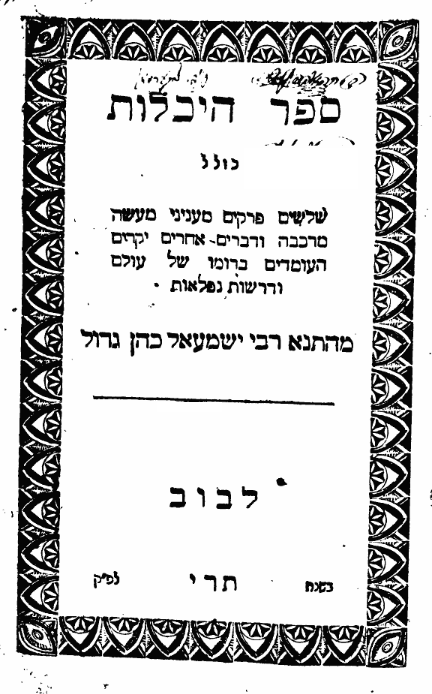

Hekhal publishes the whole tractate in Hebrew and English with a full apparatus. Sefaria's community English covers chapter 1; no earlier English of chapters 2 to 7 or of the closing hymn is known to us.
Massekhet Hekhalot: the Tractate of the Palaces
Massekhet Hekhalot reads like a guided tour of the heavenly court, written as a tractate. It begins with the names God and His throne share, each proved from Scripture, and then measures the throne in God’s own parasangs, describes the sapphire footstool beneath it, the floor of Aravot full of burning coals and precious stones, the hosts that fill the seventh palace, and the four camps of angels under Michael, Gabriel, Uriel and Raphael with the Shekhinah in their midst. It closes with a hymn to the throne that does not rest on the ground of heaven but hovers like a bird, a song R. Akiva is said to have learned when he descended to the chariot.
The tractate gathers material that also appears in Heikhalot Rabbati and the other Hekhalot texts, in a form close to the Talmud’s own question-and-proof style. Sefaria’s community English covers its first chapter. As far as Hekhal has been able to find, the rest has not been published in English before; Klaus Herrmann’s critical edition of 1994 translates it into German. Corrections are welcome.
Cross-references- Heikhalot Rabbati: the larger palace text whose hymns and throne imagery the tractate shares.
- 1 Enoch, the Book of the Watchers: chapter 14 tells of Enoch’s ascent to a heavenly house and a lofty throne.
- Merkavah: the chariot-throne of Ezekiel 1.
- Tradition
- jewish-mysticism
- Language
- Hebrew
- Period
- date uncertain; a compilation of Hekhalot and Merkavah traditions, first printed by A. Jellinek in 1853
- Attribution
- Anonymous (traditions ascribed to R. Ishmael and R. Akiva)
- Translator
- Hekhal Targum Project (machine-assisted draft; pending scholarly review)
- License
- Hebrew text public domain (Eisenstein, Otzar Midrashim, 1915); Hekhal English rendering + apparatus CC-BY-SA-4.0
- Provenance
- Hebrew from J.D. Eisenstein, Otzar Midrashim (New York, 1915), which reprints A. Jellinek, Bet ha-Midrasch II (1853) and the Arzei Levanon print, taken from Sefaria (public domain), fetched 2026-11-10. The Hebrew letters are Eisenstein's, unchanged. His editorial notes, set in small type, are removed from the Hebrew and reported in the notes of each chapter; words he prints in brackets are kept; the paragraphing is Hekhal's. A print collation against Jellinek and against Herrmann's critical edition is an open editor item.
- Source
- https://www.sefaria.org/Otzar_Midrashim%2C_Hekhalot%2C_Tractate_Hekhalot
Prior English translations
Hekhal does not claim to be the first English translation of a work where one already exists. Where prior translations are known they are listed here with their rights status, so a reader can see exactly what this edition adds and what it does not.
- Sefaria Community Translation, undated: Sefaria.org, Otzar Midrashim, Hekhalot, Tractate Hekhalot (English, CC0)public domainA CC0 community English of chapter 1 only.
- Herrmann, Klaus, 1994: Massekhet Hekhalot: Traktat von den himmlischen Palaesten. Edition, Uebersetzung und Kommentar (Mohr Siebeck)in copyrightThe critical edition, with a German translation and commentary. Not English.
Further reading
Stable URLs are part of the editorial commitment. This address will not change.
Anonymous (traditions ascribed to R. Ishmael and R. Akiva). "Massekhet Hekhalot." Hekhal: An Open Reference for Esoteric Tradition. Last modified November 11, 2026. https://hekhal.org/texts/massekhet-hekhalot.
Anonymous (traditions ascribed to R. Ishmael and R. Akiva). 2026. "Massekhet Hekhalot." Hekhal: An Open Reference for Esoteric Tradition. https://hekhal.org/texts/massekhet-hekhalot.
Anonymous (traditions ascribed to R. Ishmael and R. Akiva). "Massekhet Hekhalot." Hekhal: An Open Reference for Esoteric Tradition, Nov 11, 2026, hekhal.org/texts/massekhet-hekhalot.
Anonymous (traditions ascribed to R. Ishmael and R. Akiva). (2026). Massekhet Hekhalot. Hekhal: An Open Reference for Esoteric Tradition. https://hekhal.org/texts/massekhet-hekhalot
@misc{hekhal-texts-massekhet-hekhalot-2026,
  author       = {{Anonymous (traditions ascribed to R. Ishmael and R. Akiva)}},
  title        = {{Massekhet Hekhalot}},
  year         = {2026},
  publisher    = {{Hekhal: An Open Reference for Esoteric Tradition}},
  url          = {https://hekhal.org/texts/massekhet-hekhalot},
  urldate      = {[date accessed]}
} Free · Reader's edition
Take this text with you.
This edition as a book: the original and the English facing each other, the full apparatus and notes, a citation line and the licence, typeset to print or to read on an e-reader. The text stays free online; the files are yours to keep and share.
- PDF · 4 pp · 90 KB
- ePub · 5 KB
- Original + English
- Full apparatus
- Cite-ready
Included The whole of Massekhet Hekhalot in one volume: 8 parts, 113 pages.
Your files
Want a text that is not translated yet? Sponsor its translation.